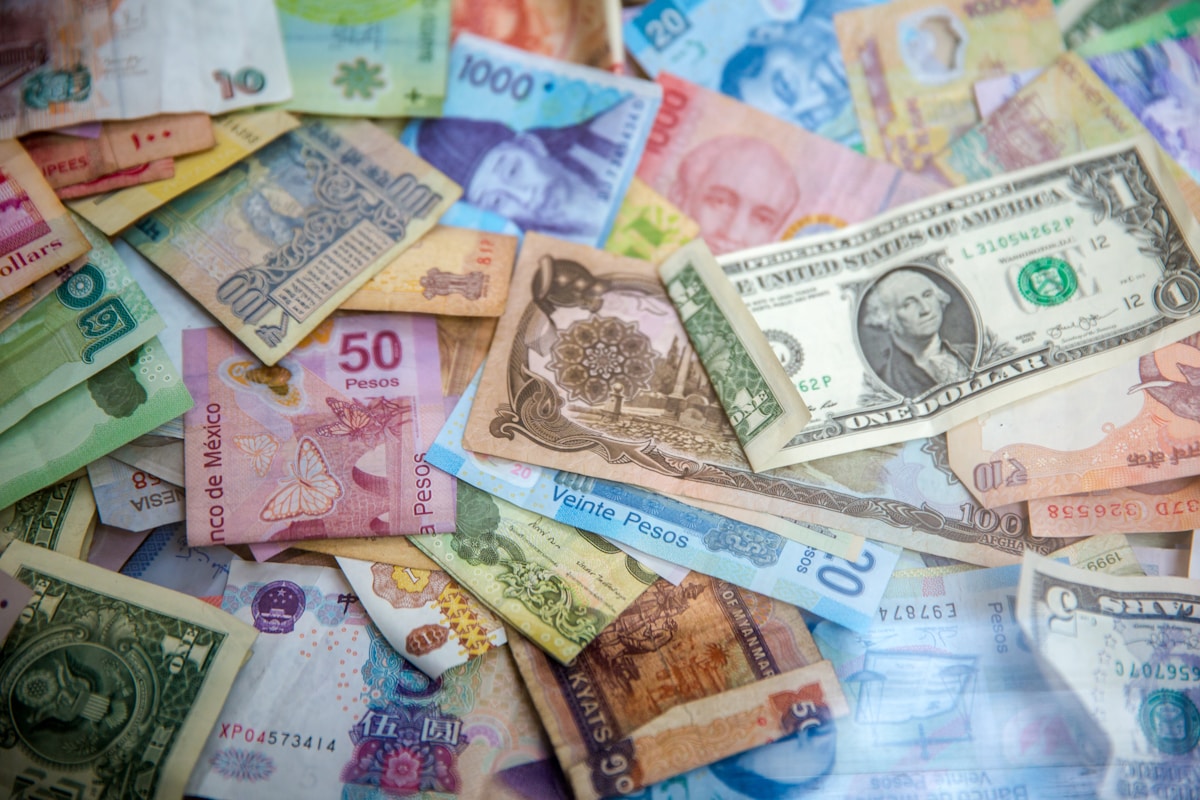
When a US investor buys shares of a Japanese company, they are making two simultaneous investments: one in the Japanese stock, and one in the Japanese yen relative to the US dollar. If the yen weakens by 10% against the dollar while the Japanese stock gains 15%, the US investor's actual return is approximately 4.5% — not 15%. Currency movements are one of the most underappreciated sources of return variation in international investing, capable of adding or destroying double-digit percentage points of return in a single year.
This guide explains how currency risk works in practice, when hedging makes sense, and the tools available to manage or exploit currency exposure.
How Currency Risk Affects International Returns
The return to a US investor in a foreign stock is approximately:
Total return ≈ Local stock return + Currency return
Consider a concrete example: In 2022, the Japanese Nikkei 225 returned approximately +1% in yen terms. However, the yen depreciated approximately 15% against the dollar that year. A US investor in a Japan index fund lost approximately 14% in dollar terms despite the Japanese market being nearly flat. Conversely, in years when the dollar weakens, US investors in international stocks receive a currency tailwind that amplifies local-currency returns.
The Bank for International Settlements (BIS) estimates that currency movements add approximately 3–5% of annualized volatility to international equity portfolios for US-based investors — a meaningful increase above the local-currency volatility of the underlying stocks.
Understanding Exchange Rate Drivers
Interest rate differentials (the carry trade): The most powerful short-to-medium term driver of exchange rates. Currencies of countries with higher interest rates tend to appreciate as global capital seeks higher yields. The "carry trade" — borrowing in a low-interest-rate currency (like the Japanese yen at near-zero rates) and investing in a high-interest-rate currency (like the Australian dollar or Mexican peso) — has been a staple of macro hedge funds for decades. The carry trade works until it doesn't: when risk appetite collapses, carry trades unwind violently as borrowed currencies strengthen suddenly (the classic "yen squeeze").
Purchasing Power Parity (PPP): The long-run theory that exchange rates should adjust to equalize the price of identical goods across countries. The Economist's "Big Mac Index" — which compares the price of McDonald's Big Mac burgers globally — is a playful application of PPP. Over 10–20 year horizons, currencies of countries with persistently higher inflation tend to depreciate against currencies of lower-inflation countries. Currencies of countries with persistent current account deficits also tend to depreciate over time.
Current account and capital flows: Countries that consistently export more than they import (current account surplus) — like Germany, Japan, South Korea, and China — tend to see long-term currency appreciation. Countries with persistent current account deficits (like the US, UK, and Australia) require constant capital inflows to fund the deficit, making their currencies potentially vulnerable if capital flows reverse.
Political and risk events: Brexit caused the British pound to fall 10% in hours on June 24, 2016. The Turkish lira lost more than 40% of its value against the dollar in 2021 as President Erdogan pressured the central bank to cut rates despite 80%+ inflation. Political risk is a major driver of currency volatility in emerging and some developed markets.
Hedged vs Unhedged International ETFs
The most practical decision for retail international investors is whether to use currency-hedged or unhedged ETFs:
Unhedged funds (VEA, EFA, VXUS) hold foreign stocks and are fully exposed to currency fluctuations. They benefit from dollar weakness (typically during US recessions when the Fed cuts rates) and are hurt by dollar strength. Unhedged funds also benefit from the diversification that currency exposure provides — the dollar tends to strengthen during global recessions, partially offsetting stock losses; it tends to weaken during global expansions, amplifying international stock gains.
Currency-hedged funds (HEDJ for Europe, DXJ for Japan, HEFA for developed markets) use rolling currency forward contracts to neutralize exchange rate movements, delivering the pure local-currency stock return. Hedging costs money — typically 0.5–2% annually depending on the interest rate differential between the US and the target country. When US interest rates are higher than foreign rates (as in 2022–2024), hedging actually adds return for US investors (you earn the interest rate differential). When US rates are lower than foreign rates, hedging costs reduce returns.
The academic evidence (Perold and Schulman, 1988; Black, 1989) suggests that for long-term investors with 10+ year horizons, the diversification benefit of unhedged currency exposure adds enough value to offset the added volatility — partial hedging (50%) is optimal for most portfolios. For investors with shorter horizons or specific currency views, selective hedging makes sense.
The Dollar Index (DXY) as a Portfolio Signal
The US Dollar Index (DXY) measures the dollar against a basket of six major currencies (euro 57.6%, yen 13.6%, pound sterling 11.9%, Canadian dollar 9.1%, Swedish krona 4.2%, Swiss franc 3.6%). A rising DXY is generally negative for: international stock returns to US investors (currency headwind), emerging market equities (EM countries often have dollar-denominated debt that becomes more expensive), and gold (dollar-denominated commodity). A falling DXY is generally positive for all three. Tracking the DXY provides useful macro context for international portfolio positioning.
Sources & Trading Risk Note
This article is for educational purposes only and is not financial advice. Trading involves risk, leveraged products can amplify losses, and market rules or evaluation terms can change. Verify current contract specs, exchange rules, and firm-specific terms before trading.




💬 Comments (0)
No comments yet. Be the first to share your thoughts!