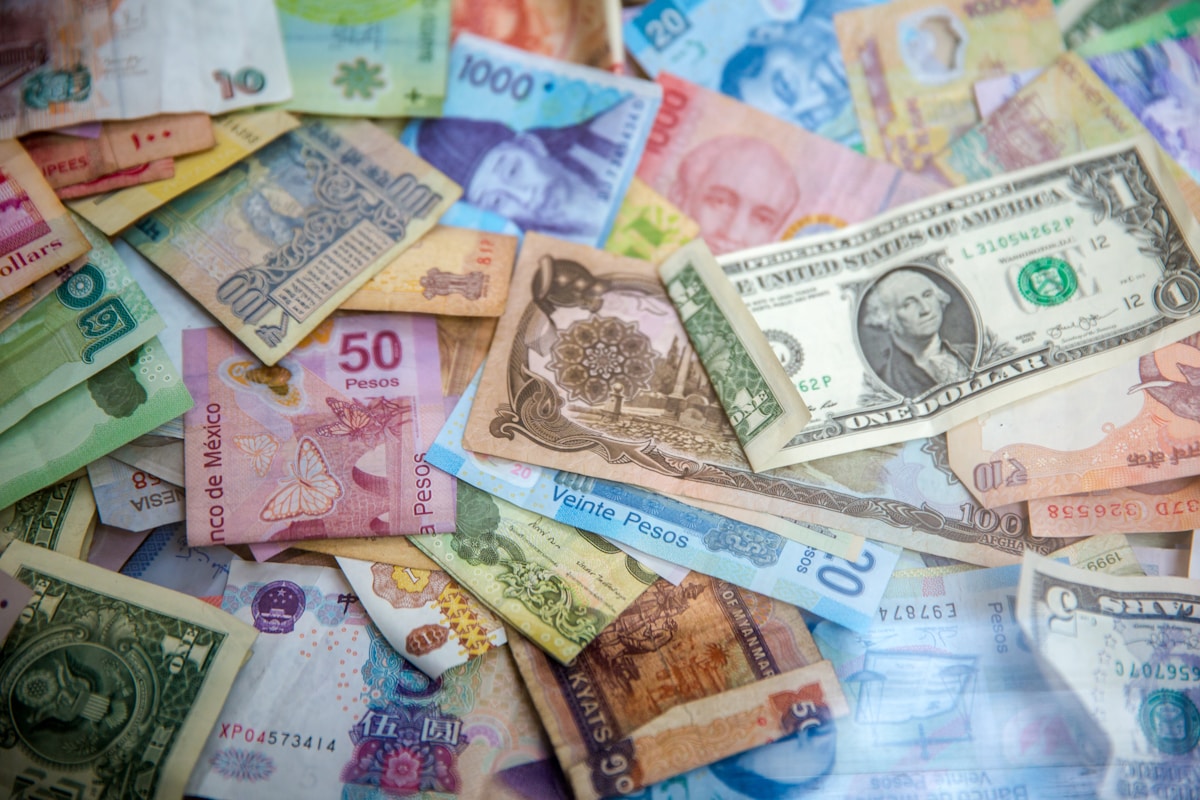
The foreign exchange market is the largest and most liquid financial market on Earth, with daily trading volume exceeding $7.5 trillion according to the Bank for International Settlements. That is more than the combined daily volume of the New York Stock Exchange, Nasdaq, and every stock exchange in the world. Yet forex trading remains largely misunderstood by retail traders who approach it with stock-market thinking — and quickly discover that currencies behave very differently from equities.
Unlike stocks, currencies are always traded in pairs. When you buy EUR/USD, you are simultaneously buying euros and selling U.S. dollars. When you close the trade, you reverse the transaction. Profit comes from the change in the exchange rate between the two currencies during the time you hold the position. As of June 2026, EUR/USD trades near 1.0847, USD/JPY near 154.32, and the DXY dollar index at 104.2 — levels that reflect the Federal Reserve's 3.63 percent policy rate holding relatively firm while other central banks begin easing cycles. Understanding these macro dynamics is the foundation of profitable forex trading.
Major Currency Pairs and What They Represent
Forex pairs are divided into three categories: majors, minors (crosses), and exotics. Beginners should start exclusively with major pairs — the seven most heavily traded pairs, all involving the U.S. dollar — because they offer the tightest spreads, highest liquidity, and the most reliable technical behavior.
EUR/USD (Euro / U.S. Dollar) is the world's most traded currency pair, accounting for approximately 23 percent of global forex volume. It is driven primarily by the interest rate differential between the European Central Bank and the Federal Reserve, and by relative economic growth between the eurozone and the United States.
USD/JPY (U.S. Dollar / Japanese Yen) is the second most traded pair. Japan's ultra-low interest rate policy has kept the yen under persistent pressure, pushing USD/JPY above 150 for the first time since the 1990s. The Bank of Japan's slow shift toward policy normalization is the dominant theme for this pair in 2026.
GBP/USD (British Pound / U.S. Dollar), nicknamed Cable, is known for its volatility and wide daily ranges. The pound is influenced by Bank of England policy, UK economic data, and post-Brexit trade dynamics.
USD/CHF (U.S. Dollar / Swiss Franc) moves inversely to EUR/USD much of the time, as Switzerland's close economic ties to the eurozone make the franc heavily correlated with the euro. The franc is also a traditional safe-haven currency, strengthening during periods of global risk-off sentiment.
AUD/USD and NZD/USD are commodity-linked currencies — Australia's dollar moves with iron ore and coal prices, New Zealand's with dairy. Both are sensitive to Chinese economic data, as China is the largest trading partner of both nations.
How to Read a Forex Quote
Every forex quote shows two prices: the bid (what the market will buy from you, always the lower price) and the ask (what the market will sell to you, always the higher price). You buy at the ask and sell at the bid. The difference is the spread — the broker's compensation.
A pip (percentage in point) is the smallest standardized price move in forex, typically the fourth decimal place for most pairs. EUR/USD moving from 1.0847 to 1.0852 has moved 5 pips. For USD/JPY, which is quoted to two decimal places, a move from 154.32 to 154.37 is 5 pips.
A standard lot is 100,000 units of the base currency. For EUR/USD, one standard lot is €100,000. Because most retail traders cannot trade full lots, brokers offer mini lots (10,000 units) and micro lots (1,000 units). A 1-pip move on a standard EUR/USD lot equals approximately $10. On a mini lot, $1. On a micro lot, $0.10. Understanding lot sizing is critical for calculating both potential profit and risk before entering any trade.
Leverage in Forex: Power and Peril
Forex brokers offer leverage of up to 50:1 for retail traders in the United States (regulated by the CFTC and NFA) and up to 500:1 at offshore brokers. Leverage amplifies both gains and losses proportionally.
With 50:1 leverage, a $2,000 account deposit controls $100,000 of currency ($100,000 / 50 = $2,000 margin required). A 2 percent move against your position wipes out the entire $2,000 deposit. This is why the majority of retail forex accounts lose money — not because forex is inherently unwinnable, but because excessive leverage combined with no stop-loss discipline is a formula for rapid account destruction.
Professional forex traders rarely use more than 5:1 to 10:1 effective leverage, regardless of what their broker offers. A 10:1 leveraged position means a 10 percent adverse move — which is very possible in a single week of volatile trading — results in a 100 percent loss of the margin deployed. Always calculate your effective leverage (total position size divided by account equity) and keep it at or below 10:1 as a beginner.
Fundamental Drivers of Currency Prices
Currency values reflect the relative economic health and monetary policy stance of two countries. Understanding the key fundamental drivers allows you to develop a directional bias before looking at charts.
Interest rate differentials are the single most powerful driver of exchange rates. Capital flows toward higher yields. When the Federal Reserve holds rates at 3.63 percent while the ECB cuts to 2.0 percent, the yield advantage of U.S. dollar assets attracts capital into dollars and pushes EUR/USD lower. The carry trade — borrowing in a low-rate currency and investing in a high-rate currency — is one of the most persistent strategies in institutional forex.
Inflation data (CPI) drives currency moves because it dictates central bank policy. Hotter-than-expected inflation typically strengthens a currency by raising expectations for rate hikes. Cooler inflation weakens it. U.S. CPI release days are among the highest-volatility events in forex markets — EUR/USD can move 100 to 150 pips in seconds when CPI surprises.
GDP growth and labor market data signal economic strength or weakness. The U.S. Non-Farm Payrolls (NFP) report, released the first Friday of each month, is the single most market-moving scheduled data release for USD pairs. A strong NFP number typically strengthens the dollar; a weak reading weakens it.
Political risk and safe-haven flows cause sharp, often sudden currency moves. The U.S. dollar and Swiss franc strengthen during crises as global capital seeks safety. The Japanese yen, despite Japan's low yields, also benefits from safe-haven flows because Japan is a massive net creditor nation and investors repatriate yen-denominated capital during global stress events.
Technical Analysis for Forex
Forex is one of the best markets for technical analysis because the large number of institutional participants who all watch the same major levels creates self-fulfilling support and resistance. Round numbers (1.0800, 1.1000 for EUR/USD; 150.00 and 155.00 for USD/JPY) consistently act as significant levels precisely because so many traders have orders clustered there.
The most useful technical tools for forex traders are horizontal support and resistance, trend lines, the 50-day and 200-day moving averages on the daily chart, and Fibonacci retracement levels. In trending markets, the 50-day moving average provides reliable dynamic support and resistance for swing entries. In ranging markets, fade the extremes — sell near resistance, buy near support — with stops just beyond the range boundaries.
The daily chart is the most important timeframe for swing forex traders. It filters out intraday noise and shows the dominant trend clearly. Once you identify a daily chart trend and a pullback to a support level, drop to the 4-hour chart to time the entry more precisely. This multi-timeframe approach — using the daily for direction and the 4-hour for entry — is the standard methodology used by professional forex traders globally.
Choosing a Forex Broker
Regulatory oversight is the most important criterion when selecting a forex broker. In the United States, brokers must be registered with the CFTC and be members of the NFA. The two largest regulated U.S. forex brokers are OANDA and Forex.com. Both offer tight spreads on major pairs, reliable execution, and educational resources for beginners.
Outside the U.S., reputable regulators include the FCA (UK), ASIC (Australia), and CySEC (Cyprus). Avoid any broker not regulated by a recognized authority, regardless of the leverage or bonuses offered — unregulated offshore brokers have a long history of fraud, manipulation, and refusal to process withdrawals.
Key factors when comparing brokers: EUR/USD spread (aim for below 1 pip on ECN accounts), minimum deposit ($100-$500 for micro accounts), trading platform (MetaTrader 4 or 5 is the industry standard), and execution speed. Many brokers offer demo accounts with paper money — always practice for at least 60 days on a demo account before trading real capital.
The Bottom Line
Forex trading is not gambling — it is the world's largest professional market, operating 24 hours a day five days a week, driven by macroeconomic fundamentals and technical dynamics that are learnable and systematic. The edge comes from understanding interest rate differentials, reading economic data in context, and executing technical setups with strict risk management.
Start with EUR/USD. Learn to read a daily chart. Trade micro lots until your account grows consistently. Never risk more than one to two percent of your capital on a single trade. Keep leverage below 10:1 regardless of what your broker offers. The traders who succeed in forex do not do so because they have access to special information — they succeed because they are disciplined, systematic, and patient in a market that punishes impulsiveness harshly and rewards methodical thinking generously.
Official Resources
For further research, the following official sources provide authoritative information on the topics covered in this article.
- Bank for International Settlements — BIS triennial FX survey — official global forex market size data
- CFTC — Commodity Futures Trading Commission — U.S. regulator for forex and derivatives markets
- Federal Reserve Foreign Exchange — Official Federal Reserve foreign exchange rate data
Sources & Trading Risk Note
This article is for educational purposes only and is not financial advice. Trading involves risk, leveraged products can amplify losses, and market rules or evaluation terms can change. Verify current contract specs, exchange rules, and firm-specific terms before trading.




💬 Comments (0)
No comments yet. Be the first to share your thoughts!