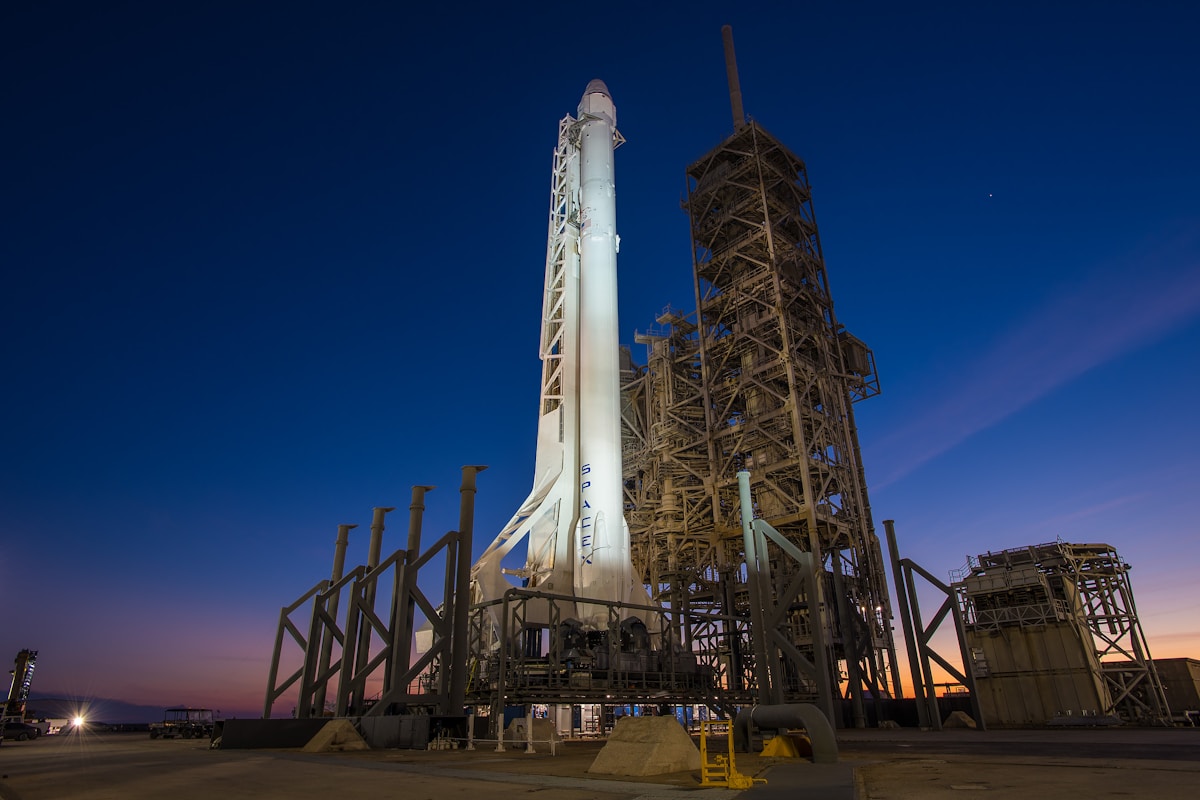
SpaceX is going public. The most valuable private company in history — founder Elon Musk's rocket and satellite internet company — filed its S-1 with the SEC on May 20, 2026 and is eyeing a listing date of June 12, 2026, according to a Wall Street Journal report published June 3, 2026. The targeted valuation: roughly $1.75 trillion.
That would make SpaceX one of the largest IPOs in history and one of the largest companies on any public exchange. For context: Apple, the world's most valuable publicly traded company, trades around a $3.3–3.5 trillion market cap. A $1.75 trillion SpaceX would debut at roughly half of Apple's size — as a company that has never before traded publicly and whose primary businesses include launching rockets and beaming internet from orbit.
Here is everything you need to know before the SpaceX IPO.
The $1.75 Trillion Question: What Are You Actually Buying?
SpaceX operates three distinct business units, each at a different stage of maturity and commercial viability:
1. Launch Services
SpaceX is the dominant commercial launch provider on Earth. The Falcon 9 — the world's first orbital-class reusable rocket — has conducted hundreds of successful launches with a reliability rate that no competitor has matched. The Falcon Heavy provides heavy-lift capability. SpaceX holds contracts with NASA (Commercial Crew Program, Artemis lunar missions), the US Department of Defense, commercial satellite operators, and other national space agencies.
Starship — SpaceX's next-generation fully reusable super heavy-lift vehicle — is the long-term future of the launch business. Starship is designed to carry up to 150 metric tons to low Earth orbit on a fully reusable basis, which would reduce the cost per kilogram to orbit by an order of magnitude relative to any existing system. Starship test flights have been ongoing through 2024–2026, with increasing success milestones.
2. Starlink
Starlink is SpaceX's satellite internet constellation — a low Earth orbit network of thousands of satellites providing broadband internet coverage globally. Starlink is SpaceX's most significant near-term revenue driver and the primary business that investors will use to justify a $1.75 trillion valuation.
Starlink has expanded into aviation (in-flight WiFi partnerships with American Airlines and others), maritime, military communications (Ukraine, US DoD), and enterprise customers. The service has expanded to over 100 countries and crossed into profitability ahead of schedule. Exact subscriber counts and revenue figures are not publicly disclosed — the S-1 will contain the first authoritative figures.
3. SpaceX Government Contracts
SpaceX holds significant long-term contracts with US government agencies. The NASA Commercial Crew Program — under which SpaceX's Crew Dragon ferry astronauts to and from the International Space Station — is worth billions. Artemis contracts for lunar landing systems add further government revenue. DoD contracts cover national security satellite launches.
The Bitcoin Disclosure: 18,712 BTC on the Balance Sheet
One of the most notable disclosures in SpaceX's S-1 filing was the revelation of its Bitcoin holdings: 18,712 BTC, according to BitcoinTreasuries.net's analysis of the filing (May 21, 2026). At the time of filing, with Bitcoin trading around $77,500, the position was worth approximately $1.45 billion. At current prices of approximately $67,000 (June 3, 2026), the value is approximately $1.25 billion.
Prior public estimates from blockchain analytics firm Arkham Intelligence had put SpaceX's Bitcoin holdings at approximately 8,285 BTC — the actual disclosed amount was more than double that estimate. Upon listing, SpaceX will become the 7th largest public company Bitcoin holder, surpassing Tesla (11,509 BTC), Coinbase (16,492 BTC), and Strive (19,000 BTC — itself a newer position). It falls behind Strategy (843,706 BTC), Twenty One Capital (43,514 BTC), and Metaplanet (40,177 BTC).
Elon Musk is expected to retain more than 85% voting control over SpaceX post-IPO through a multi-class share structure — meaning Bitcoin treasury decisions, like all major strategic decisions, remain effectively under his discretion.
Why SpaceX Is Going Public Now
SpaceX has been private by choice for years, raising capital through secondary transactions and venture rounds that valued it at successively higher levels. The decision to IPO now reflects several converging factors:
- Starlink maturity: The satellite internet business has reached the scale where public market investors can underwrite a meaningful revenue projection. Profitability and subscriber growth give public market investors a computable story beyond "space is cool."
- Employee liquidity: SpaceX has thousands of employees with stock-based compensation. Private company restrictions on share sales create retention pressure as employees watch years of vested equity stay illiquid. An IPO solves this.
- Capital for Starship: Starship's development and the build-out of full global Starlink coverage require capital at a scale that even SpaceX's private fundraising history struggles to address. Public markets provide access to trillions in institutional capital.
- Market conditions: The S&P 500 is at an all-time high of 7,609. IPO windows open when markets are buoyant, and 2026 is one of the most favorable IPO environments since 2021.
The Competitive Landscape SpaceX Dominates
To understand the $1.75 trillion valuation, you need to understand the degree to which SpaceX has separated itself from every competitor in commercial launch:
- United Launch Alliance (ULA): The Boeing-Lockheed joint venture that dominated US government launch for decades. ULA's Vulcan Centaur is its next-generation vehicle, but costs remain far above SpaceX's Falcon 9.
- Rocket Lab: A credible small-payload competitor with the Electron rocket, now developing the medium-lift Neutron. Rocket Lab is publicly traded but operates at a fraction of SpaceX's scale and capability.
- Blue Origin: Jeff Bezos's company has the New Shepard suborbital vehicle and New Glenn heavy-lift rocket. Blue Origin is privately funded with no public financials and no commercial launch track record comparable to Falcon 9.
- Arianespace / ESA: Europe's launch consortium with the Ariane 6 rocket. Ariane 6 has faced delays and cost overruns; its per-launch cost is significantly above Falcon 9's reusability-driven pricing.
SpaceX's Falcon 9 reusability — landing first stages and reusing them up to dozens of times — has structurally broken the economics of every competitor that uses expendable vehicles. Starship, if it reaches operational status, would repeat that disruption at a scale 10x larger.
The Risks Every Investor Must Understand
A $1.75 trillion valuation is an extraordinary number for a company in a capital-intensive industry that has never before disclosed public financials. The risks are real and material:
- Valuation justification: The valuation is entirely dependent on Starlink's growth trajectory and Starship's successful commercialization. If either underperforms, the multiple collapses. Public market investors have not previously had access to actual Starlink revenue figures — the S-1 will be the first read.
- Elon Musk concentration risk: With >85% voting control, SpaceX's strategic direction is entirely contingent on Musk's decisions, attention, and priorities. Musk simultaneously runs Tesla, xAI, and (previously) Twitter/X. Key-person risk at this scale is extraordinary.
- Starship execution risk: Starship's development timeline has slipped multiple times. The vehicle is still in flight testing. If Starship's commercialization delays, the long-term revenue projections that justify $1.75T become significantly less certain.
- Regulatory risk: SpaceX's business is deeply entangled with the US government — FAA launch approvals, DoD contracts, FCC spectrum licenses for Starlink. Regulatory friction in any of these areas creates business risk that private companies can manage quietly but public companies must disclose.
- Geopolitical risk: Starlink has become geopolitically significant (Ukraine conflict usage, national security applications). This creates risks that commercial satellite internet providers have never previously navigated at scale.
How to Think About the IPO as a Trader
Large, high-profile IPOs historically follow a predictable pattern in the first trading days and weeks. The IPO price is typically set to leave some "pop" for first-day buyers — institutional investors who get shares at the IPO price sell into retail demand on day one. This dynamic often creates a first-day high followed by a multi-week or multi-month pullback as the initial enthusiasm is digested.
For SpaceX specifically: the $1.75 trillion valuation number was set before the S-1 showed actual revenue and earnings. If Starlink revenue and subscriber numbers exceed market expectations, the stock will open above the IPO price and may sustain a premium. If the numbers are in line with or below expectations embedded in the $1.75T target, expect significant first-week volatility.
The smart approach for most individual investors: watch the first week of trading, note where institutional buyers step in on any pullback (rather than chasing the day-one pop), and size any position in SpaceX as a long-term hold rather than a short-term trade. This is a company whose full revenue potential — a global Starlink network, Starship commercial launch dominance, point-to-point Earth transit via rocket — will take a decade to fully materialize.
The Bottom Line
SpaceX at $1.75 trillion is either one of the most significant public market opportunities of the decade or one of the most aggressively valued IPOs in market history — possibly both. Starlink is a real, profitable, growing business. Falcon 9 is the world's most reliable and cost-effective orbital launch vehicle. Starship is the most ambitious engineering project currently underway on Earth. Elon Musk retaining 85%+ voting control means the company's direction is not subject to shareholder democracy.
The S-1 financials — which will be public before the June 12 listing — are the document that matters. Revenue growth, Starlink subscriber economics, and the path to Starship commercialization will tell you whether $1.75 trillion is a bargain or a bubble. Read the S-1 before buying the hype.
Starlink's Business Model: The Revenue Engine Behind the Valuation
Understanding the $1.75 trillion SpaceX valuation requires understanding Starlink's economics, because Starlink is the business that justifies the multiple. Launch services — the original SpaceX business — is a high-reliability, high-margin service business. But launch services alone cannot justify $1.75 trillion. Starlink is the growth engine.
Starlink's revenue model is recurring subscription revenue from consumers, enterprises, maritime operators, and governments. The consumer residential service currently operates at roughly $120/month in the US. Aviation contracts (American Airlines, others) are priced differently — a per-aircraft monthly fee. Maritime contracts cover vessels from small pleasure craft to large commercial shipping. Government/military contracts are the highest-margin and least price-sensitive segment.
The growth trajectory that public market investors need to underwrite:
- As of the S-1 filing, Starlink has launched thousands of satellites into low Earth orbit, achieving near-global coverage (excluding polar regions, some regulatory holdouts)
- The service is available in over 100 countries and across all use cases: residential, aviation, maritime, enterprise, government
- The Starlink constellation is still expanding — each additional satellite increases bandwidth capacity and redundancy, allowing Starlink to serve more concurrent users per ground area
- Starship's dramatically lower launch cost (if achieved commercially) would reduce the per-satellite deployment cost, accelerating constellation expansion and improving unit economics
The S-1 will disclose actual subscriber counts, revenue, and margins for the first time. The gap between analyst estimates and actual figures will be the primary price-moving data point when trading opens on June 12.
Elon Musk's Attention Problem: The Key-Person Risk Quantified
Any SpaceX analysis must grapple directly with the key-person concentration risk. Elon Musk is simultaneously the CEO or executive chair of: Tesla (TSLA), SpaceX, xAI (Grok), X (formerly Twitter), The Boring Company, and Neuralink. He is also a senior advisor to the current US administration.
This is not an abstract governance risk — it has measurable effects. Tesla's stock declined significantly during periods when Musk was visibly distracted by Twitter in 2022–2023. SpaceX has operated largely without public drama because it has been private and Musk has been more focused. As a public company with quarterly earnings calls and institutional shareholders, SpaceX's relationship with Musk's attention will become visible in real time.
The multi-class share structure — giving Musk >85% voting control — means that institutional shareholders have limited ability to constrain his behavior. Activists who might otherwise push for governance changes or a smaller Musk role have no mechanism to do so. This is a known risk, priced into the market's willingness to give Musk's companies elevated multiples in exchange for his operational involvement. Whether public market investors accept the same trade-off for SpaceX that Tesla investors have accepted for years remains to be seen at the IPO open.
The Broader Context: 2026 IPO Market
SpaceX is going public into one of the most favorable IPO market conditions in years. The S&P 500 is at an all-time high of 7,609. Investor appetite for technology and deep-tech companies is strong. The 2021 SPAC-era IPO bust has faded from immediate memory. Goldman Sachs has set an 8,000 year-end target for the S&P 500.
Other notable 2026 IPOs in the pipeline include Anthropic (confidential S-1 filed June 1, 2026, at a $965 billion post-money valuation). The concurrent availability of SpaceX (deep tech / space) and Anthropic (frontier AI) represents the two most anticipated IPOs of the decade arriving simultaneously — creating competition for institutional capital that might otherwise flow entirely into one or the other.
For traders: the SpaceX IPO allocation process will primarily benefit institutional investors who receive shares at the IPO price. Retail investors who buy on the first day of trading will pay the market-clearing price, which historically includes a "pop" premium above the IPO price. The first-week trading pattern — initial pop, institutional profit-taking, potential pullback — is the pattern to watch for intelligent retail entry.
SpaceX IPO valuation from The Wall Street Journal (June 3, 2026). Bitcoin holdings from BitcoinTreasuries.net (May 21, 2026). This article is for informational purposes only and does not constitute investment advice.
Official Resources
For further research, the following official sources provide authoritative information on the topics covered in this article.
- SpaceX — Official SpaceX mission and company information
- Starlink — Official Starlink satellite internet service
- SEC IPO Resources — Official SEC guide to the IPO process and disclosure requirements
Sources & Accuracy Note
Developer tooling, AI models, framework releases, benchmarks, and security advisories move quickly. Verify version numbers, release notes, and migration steps against the original project or vendor documentation before making production decisions.
💬 Comments (0)
No comments yet. Be the first to share your thoughts!